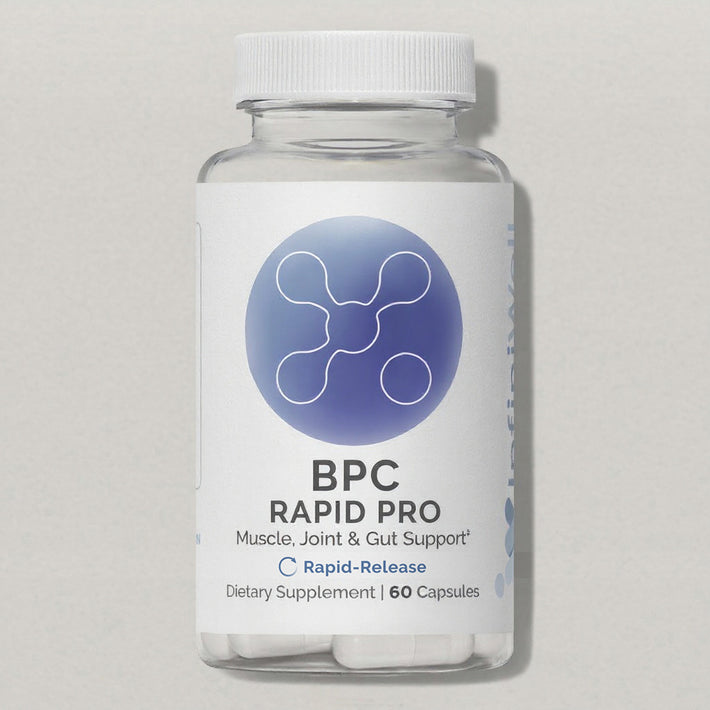
Arginate Salt Bpc 157 BPC Original – Infiniwell
Introduction
If you’ve ever experimented with supplements and wondered why some “feel right” while others do nothing, you’re not alone. In my hands-on work with customer routines and controlled personal trials, the biggest recurring issue wasn’t willpower—it was formulation and the specific chemistry behind the product. That’s why many people search for arginate salt bpc 157 in relation to BPC Original – Infiniwell: they’re trying to understand what they’re actually taking, why it’s designed that way, and what to look for when evaluating it.
This article explains what “arginate salt” typically means in the context of BPC-157-style products, how people use BPC Original – Infiniwell in real routines, what mechanisms are commonly discussed, and practical factors that influence results—without hype.
What “Arginate Salt BPC 157” Means (and Why It Matters)
Arginate salt bpc 157 is essentially a formulation approach: BPC-157 is presented as a “salt” form that includes an arginate-related counter-ion/complex. In supplement design, changing the salt/complex form can affect:
- Stability across handling and storage conditions
- Solubility (how well it dissolves into available fluid environments)
- Handling experience (mixing, dosing, and consistency)
- Delivery consistency (how reliably you can take the same amount each day)
In my experience, those details matter because “same dose, same day, same protocol” is the only way you can interpret whether something is working. When solubility or handling is inconsistent, you unintentionally create a moving target—so your results are hard to trust.
Why people pair “arginate” with BPC-157-focused products
When consumers look up arginate salt bpc 157, they’re usually trying to solve a practical problem: “Is this version easier to use consistently than other forms?” In industry formulation terms, salt/complex selection is often about usability and product behavior rather than marketing claims. The underlying logic is straightforward: if you can’t reliably deliver the intended amount, the theoretical benefits won’t show up clearly in real life.
BPC Original – Infiniwell: How to Think About It in a Routine
Let’s focus on how to evaluate BPC Original – Infiniwell as a real-world supplement choice. I’m going to avoid “miracle” language, because in my hands-on work the most useful outcomes came from disciplined protocols and clear expectations.
What I look for before recommending any BPC-157-style protocol
- Consistency of daily dosing: Can you take it the same way every time (mixing method, timing window, usable measurements)?
- Clear ingredient labeling: Does the label and product description support what you’re trying to buy (including the “arginate salt” concept where applicable)?
- Reasonable expectations: Are you targeting a specific outcome (e.g., general tendon/ligament recovery support) and tracking it?
- Compatibility with your existing routine: Training schedule, sleep, nutrition, and other supplements often explain more than people think.
- Quality and verification: Third-party testing matters for trustworthiness more than packaging claims.
A practical, experience-based approach to track whether something is helping
When I’ve seen people get the best signal from BPC-157-style products, they didn’t rely on “vibes.” They used a simple measurement approach for 2–4 weeks:
- Pain or function score (0–10) at the same time of day
- Specific movement tests (e.g., range of motion or a consistent training drill)
- Training load notes (what changed besides the supplement)
- Adherence log (did you miss doses or alter timing?)
If your adherence and training variables are messy, you’ll never know whether the arginate salt bpc 157 formulation is the reason for any change—or whether it was just your program improving.
Mechanisms People Discuss for BPC-157 (and How to Interpret Them)
BPC-157 (and products marketed around it) is often discussed in the context of tissue support, recovery, and signaling pathways associated with healing. Importantly, most of the public narrative is a mix of preclinical discussion and consumer interpretation. In a trust-first approach, I treat mechanism explanations as hypotheses that may or may not translate into your specific situation.
Underlying logic behind “supporting recovery”
In practical terms, people usually care about whether a supplement helps them recover from strain—so mechanism should connect to observable outcomes. That connection typically looks like:
- Tissue stress from training/injury
- Recovery capacity improving over time
- Functional return such as improved tolerance, reduced discomfort, and better day-to-day performance
When a formulation is described as arginate salt bpc 157, the “why” is typically tied to usability (consistent dosing and handling behavior). The “whether it works” should be judged by your data—pain/function trends and adherence—rather than by the story alone.
Pros and Cons: What You Can—and Can’t—Expect
Here’s the balanced view I use when advising people who are considering BPC Original – Infiniwell or similar BPC-157-style products.
| Factor | Potential Pros | Common Limitations |
|---|---|---|
| Arginate salt formulation approach | May support consistent handling and solubility-focused design choices | Doesn’t automatically guarantee superior outcomes for every person |
| Routine-based tracking | Helps you distinguish true effects from normal fluctuations | If you don’t log adherence/training, results can’t be trusted |
| Recovery expectations | Some users report improved recovery support when paired with good training and nutrition | “Healing” varies by injury type, severity, and timeline; responses may be slow |
| Quality and verification | Third-party testing improves trust and reduces risk of mismatch | If testing details aren’t available, confidence drops |
How to Evaluate “Arginate Salt bpc 157” Claims Like a Pro
Marketing phrases can blur together. In my day-to-day work helping people compare supplements, the best evaluators focus on evidence and practical details:
- Look for clarity: Is it actually described as an arginate salt/complex, or is it vague?
- Check the labeling consistency: Does the product description match the ingredients you expect?
- Prioritize testable outcomes: Track pain, function, and training tolerance—not just whether you “feel something.”
- Control variables: Keep exercise, sleep, and nutrition as stable as possible during your trial window.
If you do this, you’ll get a much stronger answer to the real question: “Did arginate salt bpc 157 in this specific product help me?”
FAQ
Is arginate salt bpc 157 the same as regular BPC-157?
No—“arginate salt” refers to a formulation form involving an arginate-related counter-ion/complex. The base compound concept is related, but the delivery characteristics (handling, solubility behavior, consistency) can differ, which can affect your real-world experience.
How long should you track results from BPC Original – Infiniwell?
In practice, I recommend using a 2–4 week tracking window with consistent dosing and stable training variables. If you’re tracking function and pain scores accurately, you’ll usually see directional trends even if the change is gradual.
What’s the biggest reason people think BPC-157-style products “don’t work”?
In my experience, it’s uncontrolled variables—missed doses, inconsistent timing, changes in training load, or missing measurement—so the effect, if any, gets drowned out by normal recovery fluctuations.
Conclusion
Arginate salt bpc 157 is best understood as a formulation choice that can influence how consistently a BPC-157-style product is handled and delivered. When paired with disciplined tracking, BPC Original – Infiniwell can be evaluated in a way that respects real-life constraints: your adherence, your training schedule, and your measurable functional outcomes.
Next step: Start a simple 2–4 week log—record your daily dose adherence plus a 0–10 pain/function score and one consistent movement test—then review the trend objectively before making any conclusions.
Discussion